
solidago, solidarity
we're only whole together

Have you seen them as the bee does? All those tiny daisies joining to create an inflorescence; each a community lighting up the meadows with summer’s golden swan song?
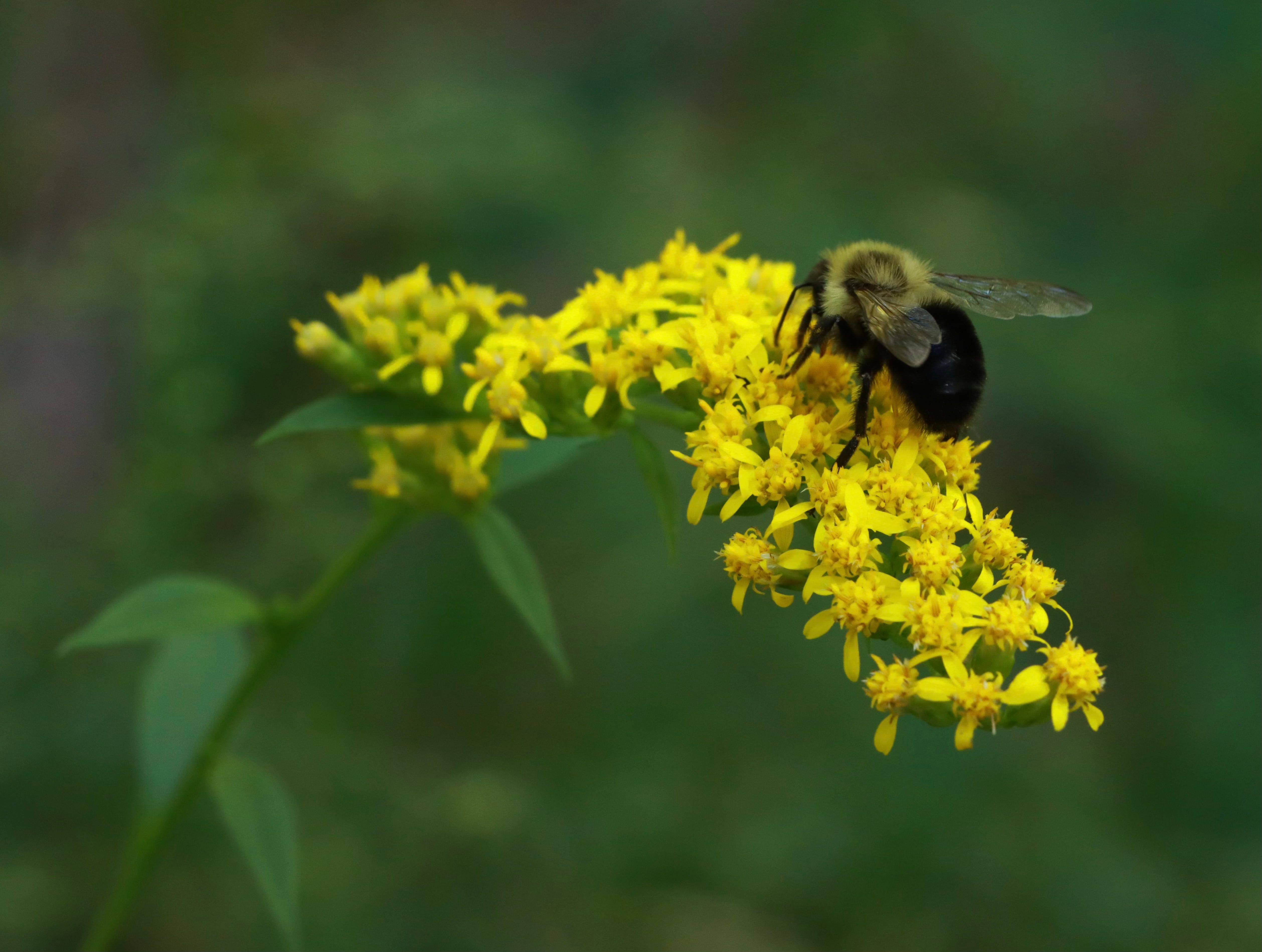
Solidago. Stemming from the Latin root solidum, meaning wholeness. From this same root stems the French word solidaire, which describes a state of being joined together by mutual responsibilities. This is the origin of our word solidarity.
Most will cite Goldenrod’s genus Solidago as derived from the Latin phrase “in solidum ago vulnera” — meaning “I make wounds whole” — in homage to the plant’s wound-healing properties.
But in Solidago, there is also solidarity. I witness: how each small flower joins together to form a spire; how each bloom depends on the strength of the stem to hold them up; and how, only together, they can create the golden vibrancy that attracts the bees. Insect-pollination is critical for Goldenrod, as the flowers’ sticky, heavy pollen* cannot be blown through the air, making them dependent on the work of bees, wasps, and other winged-ones to keep their lineage alive. Solidarity.
(*Note: Although Goldenrod gets blamed for seasonal allergies, they are not the culprit since their pollen is too heavy to be air-borne1)
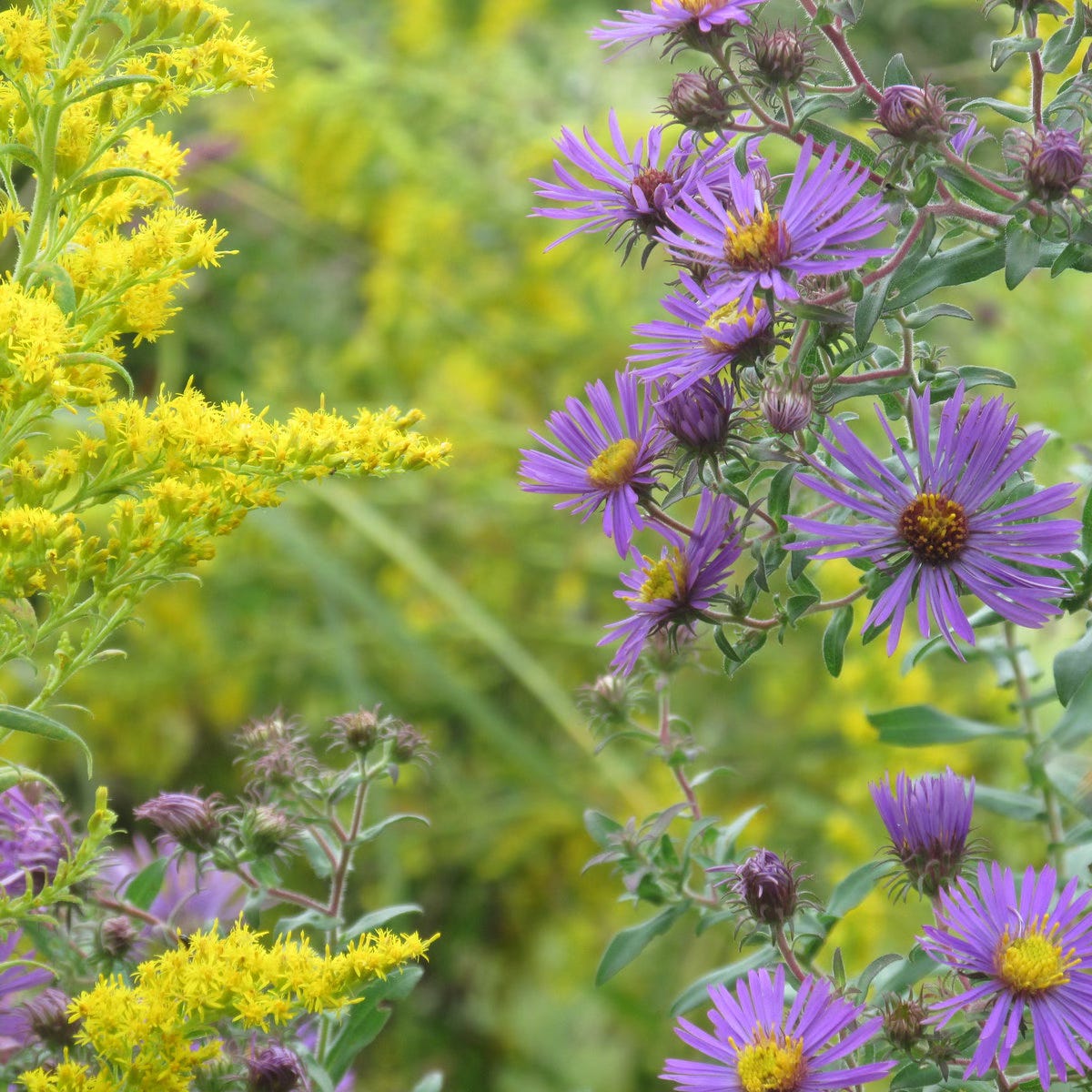
Even further, I hear Robin Wall Kimmerer’s central question in her opus, Braiding Sweetgrass: “Why do asters and goldenrod look so beautiful together?” And her answer: "That September pairing of purple and gold is lived reciprocity; its wisdom is that the beauty of one is illuminated by the radiance of the other."
In solidarity, we recognize and value interdependence. We know we are enmeshed in Indra’s net, never to be untangled. Although, in recent centuries, the Western mindset has tried to separate us from the whole— enraptured in the myths of individualism, independence, white supremacy, and private property.
To re-root in interconnection, I turn to Goldenrod. When they bloom, I see each daisy-like floret as one of us, and I see the stem they’re on as the land we inherently share. We each have the right to be here, and we depend on one another to honor the integrity of our shared space. Imagine one bloom trying to partition off their private part of the stem. The whole inflorescence would break.
The Western mindset of individualism leads to so many of us feeling downtrodden, a condition that herbalist Katja Swift treats with Goldenrod. To describe this downtrodden state, she recalls the movie “A Knight’s Tale,” highlighting the scene where the Chaucer character is “trudging.” The character then defines “to trudge” as: “the slow, weary, depressing yet determined walk of a man who has nothing left in his life except the impulse to simply soldier on.”2
Goldenrod reminds, like Naomi Murakawa3: You’ve been convinced all the glory is in being a star. But why be a star when you can be a constellation?
We don’t need focus on shining so bright that we burn out and simply soldier on. We can remember our place in the whole, in the mythic imagination, in community. We are only whole together; we are always held together. Let us reinforce the net of solidarity to protect the whole from those actively trying to dismantle our integrity.
We can call on Goldenrod to uplift us when we’re just trudging along; to reinforce our commitment to collective care; to bathe us in the golden hue of belonging.
When I seek the support of Goldenrod as an ally in solidarity, I reach for them as an herbal-infused oil. I first learned about the practice of Goldenrod body oiling from teacher jim mcdonald (via Dorothy Hall), who shares that Goldenrod can be used in the place of popular Arnica for somatic support. Best applied soon after injury or strain, Goldenrod oil can ease musculoskeletal pain and tension.
In my time with this practice, I’ve seen Goldenrod helping in this way by acting on the fascia of my body. The oil helps to loosen rigidity and tightness, especially from recent trauma or chronic patterning. This fascinates me, as the fascia form a net that surrounds and supports all the structures of my body: muscles, bones, organs, nerves, and vessels. This fascial connective tissue, joining together, is what gives my body integrity, allowing it to be a whole. My fascial net— a somatic solidarity network— supported by none other than Solidago. The spell continues on.
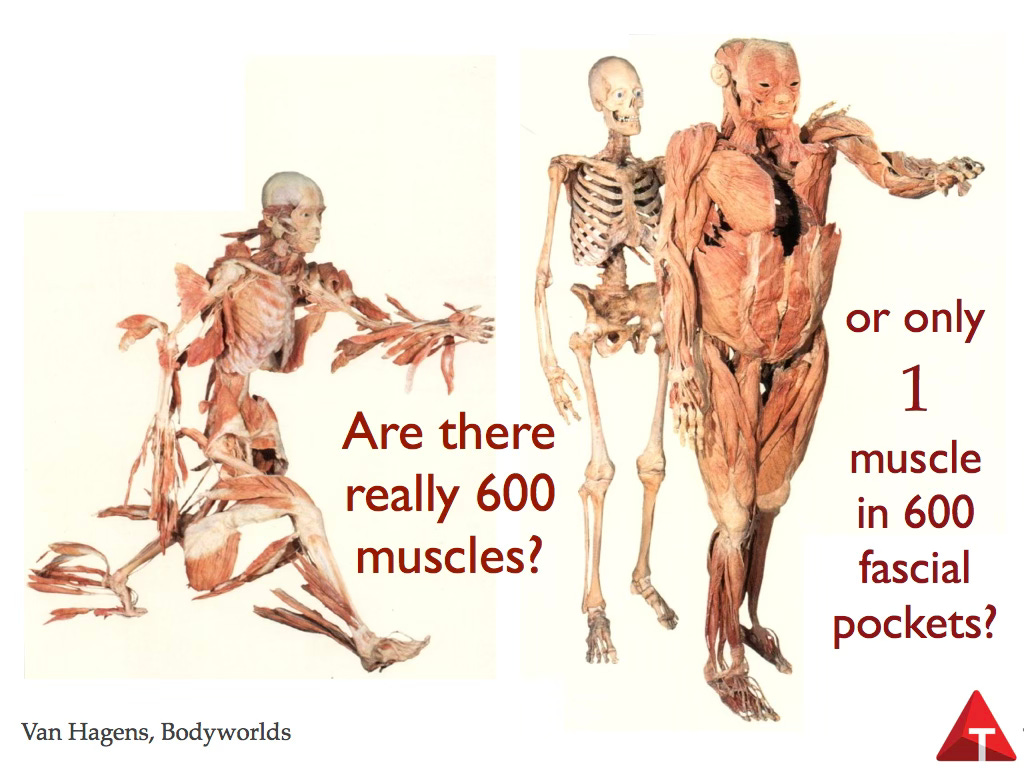
When I rub the Goldenrod oil into my neck, easing tension, I am simultaneously working to ease my hips, which are connected through a fascial line4. Meanwhile, I feel supported by the spirit of Goldenrod, who infuses me with the tenacity to keep shining so that our constellation of collective care, rooted in the animacy of the earth and the inherent worthiness of all beings, may remain bright, now and in generations to come.
I remember how Goldenrod has been so commonly cast off as a weed and allergen, although it is neither. The plant stands as an integral part of Turtle Island’s native ecosystem, acting as a late-season food source, providing shelter, and maintaining the structure of soil in the face of erosion. As Kimmerer reminds, Goldenrod’s beauty also serves as a vision of lived reciprocity: both in relation to the purple asters and in relation to all beings over centuries who have relied on this plant for delight, nourishment, and medicine.
Indigenous people of Turtle Island, including the Cherokee, Anishinaabe, Potawatomi, and Haudenosaunee, use the root, flower and leaf of native Solidago species extensively. The Haudenosaunee lean on Goldenrod as an analgesic, liver-stimulant, and nervine, especially to soothe sleeplessness in children.5 The Anishinaabe decoct the root to treat urinary tract issues.6 And the Meskwaki make a topical preparation to tend to insect bites and swollen faces.7 More uses of the plant by Indigenous tribes are documented, and I’m sure much is still not written down.
Meanwhile, to trace back to my ancestors, the European Goldenrod, Solidgo virgaurea, has been documented in Western herbalism as early as the 1400’s. One of the first modern German botanists, Hieronymus Bock (1498–1554), wrote that Germanic tribes had long been using Goldenrod medicinally and regarded it as a “miracle herb” (Wunderkraut). Another name used to refer to Goldenrod in the middle ages was “Heydnisch Wundkraut”, which translates to “heathen woundwort”, paying homage to the use of this plant by Germanic tribes (aka “heathens”) before they were colonized by the Catholic empire.8
German folk medicine employed Goldenrod largely as a vulnerary, as the woundwort name suggests, as well as a diuretic to balance the kidneys and urinary tract, which is how many herbalists continue to employ the plant today. Interestingly, to tie more into my ancestry, Appalachian settlers often refer to Goldenrod as “woundwort”, which seems to reach into the Germanic folk medicine lineage.
In this legacy of connection across timelines, I also see the rhizomatous root system that many Goldenrod species share— spreading and intertwining below ground to share nutrients and form communities. Some species, like Grey Goldenrod, even form caudex— a thickened structure at the plant’s base to store water for when it’s needed. This serves as a reservoir of resilience, sharing water with the rest of the stand through mychorrizal connections during times of drought.
Solidarity. Interconnection. Belonging. Resilience. All felt with Goldenrod on the skin; as a tea that I sip. I anchor this plant’s wisdom into my body, connecting into the ancestral and the collective. This golden light is here, in abundance, as part of us all.
now in the apothecary
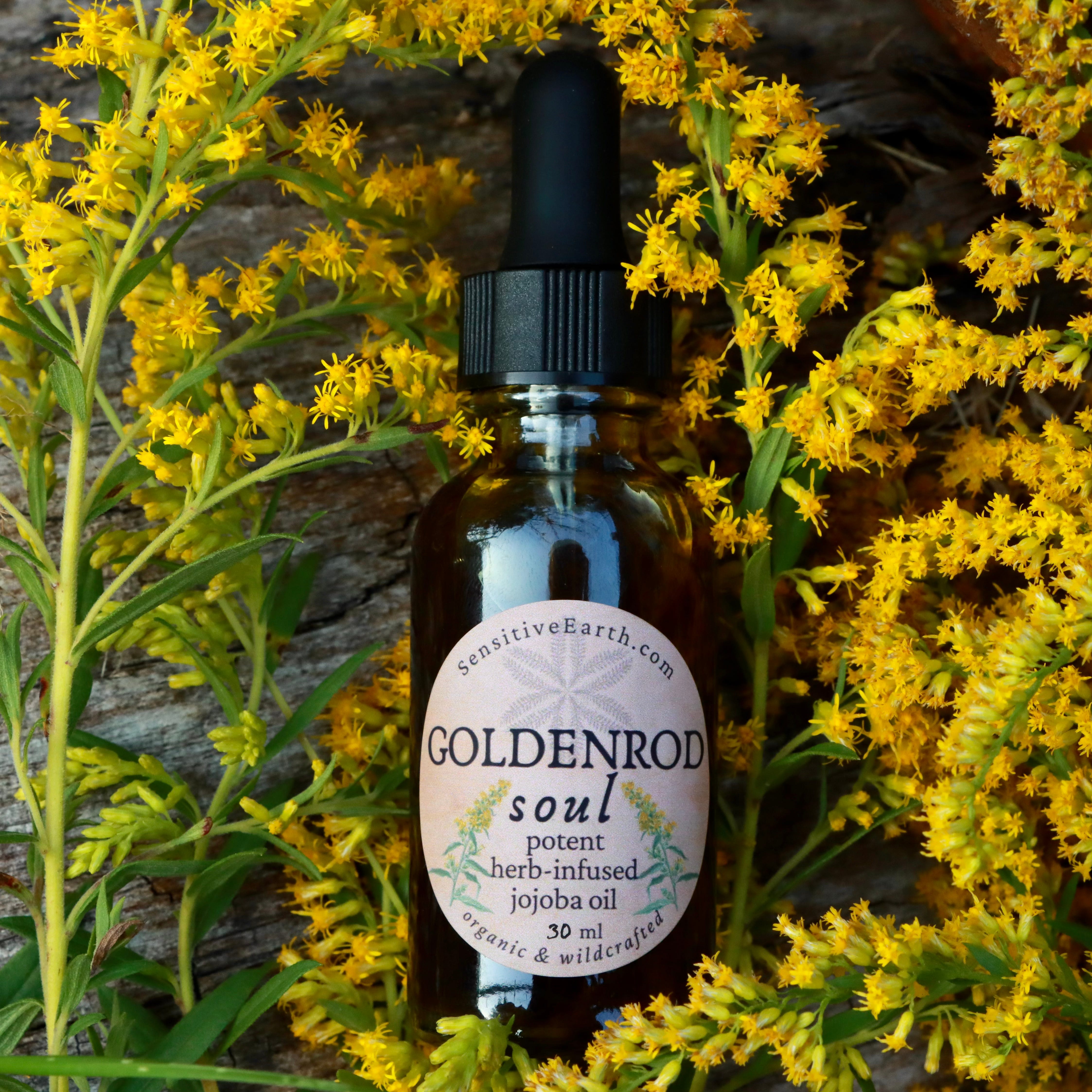
With a spicy and warming scent, Goldenrod Soul now joins my line of extra-potent herbal infused jojoba oil. I’ve been rubbing this one all over, especially on my jaw, neck, and hips to target chronic tension I hold there.
Speaking of the hips and lower back, I learned of a topical formula that helps target this area from teacher Matthew Wood. It combines Goldenrod, Mugwort, and Eastern Hemlock to bring warmth and ease to this part of the body especially.
As someone obsessed with all three of these plants and with consistent hip tension (as a toddler mom who holds a lot), I decided to craft a batch when I found a meadow of Goldenrod and Mugwort growing next to an old growth Hemlock forest in the Catskills. This birthed, Sanctuary Muscle Rub.
The scent of this is evergreen, bright, and warming. Up there with one of my favorite scents on Earth. This is a small batch to honor the integrity and sanctity of the place where the plants were harvested. It was poured into bigger 2 oz tins and solidified with local beeswax to make it easier for everyone out there rubbing their own backs. The plants and bees have got you covered.
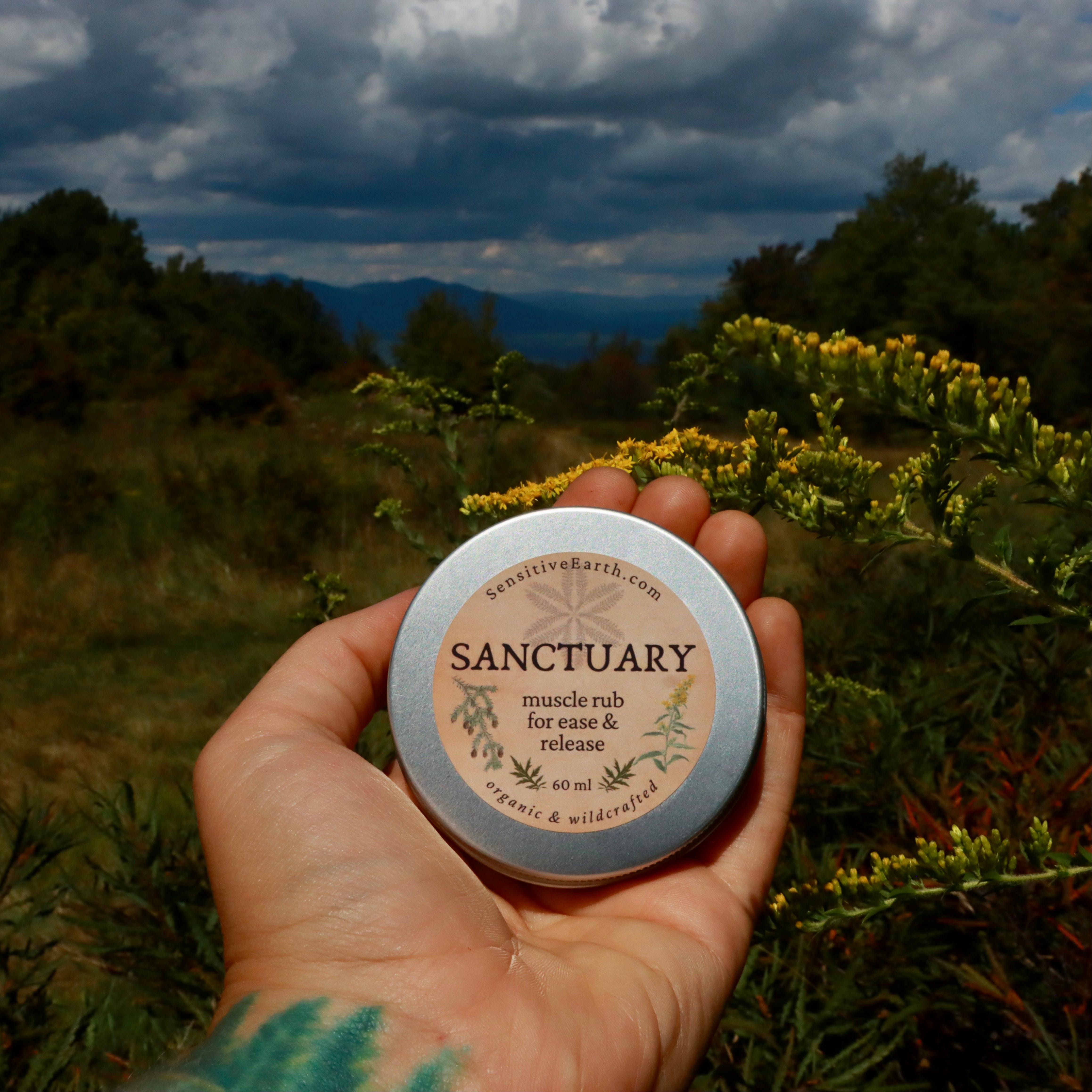
Also to note: Lavender Soul (even more potent than last year’s batch), River Body Lymph & Breast Oil, and I Weave My Web Face & Boundary Oil are all back in stock!
upcoming events
9/26: Our second to last (free!) Herbal Ally Gathering at the Rondout Community Garden is on Friday September 26th from 6-7:30pm. Come learn from the plants, harvest, and connect with a community herb garden in Kingston, NY. We’re starting a WhatsApp group— reach out if you’d like to be more in-the-know.
9/28: I will be vending the Herbs to the People gathering in Goshen, NY on September 28th. This is a place for folks to stock their apothecaries at a sliding scale rate, shop local herb-crafters, and learn from teachers in a host of workshops. Hope to see you there!
10/11: On your way to leaf-peep the Catskills, stop by the Fall Craft & Wellness Faire at 52 North Lake Road in Haines Falls, hosted by the Mountain Top Cares Coalition. Sensitive Earth apothecary will be there from 12-6pm.
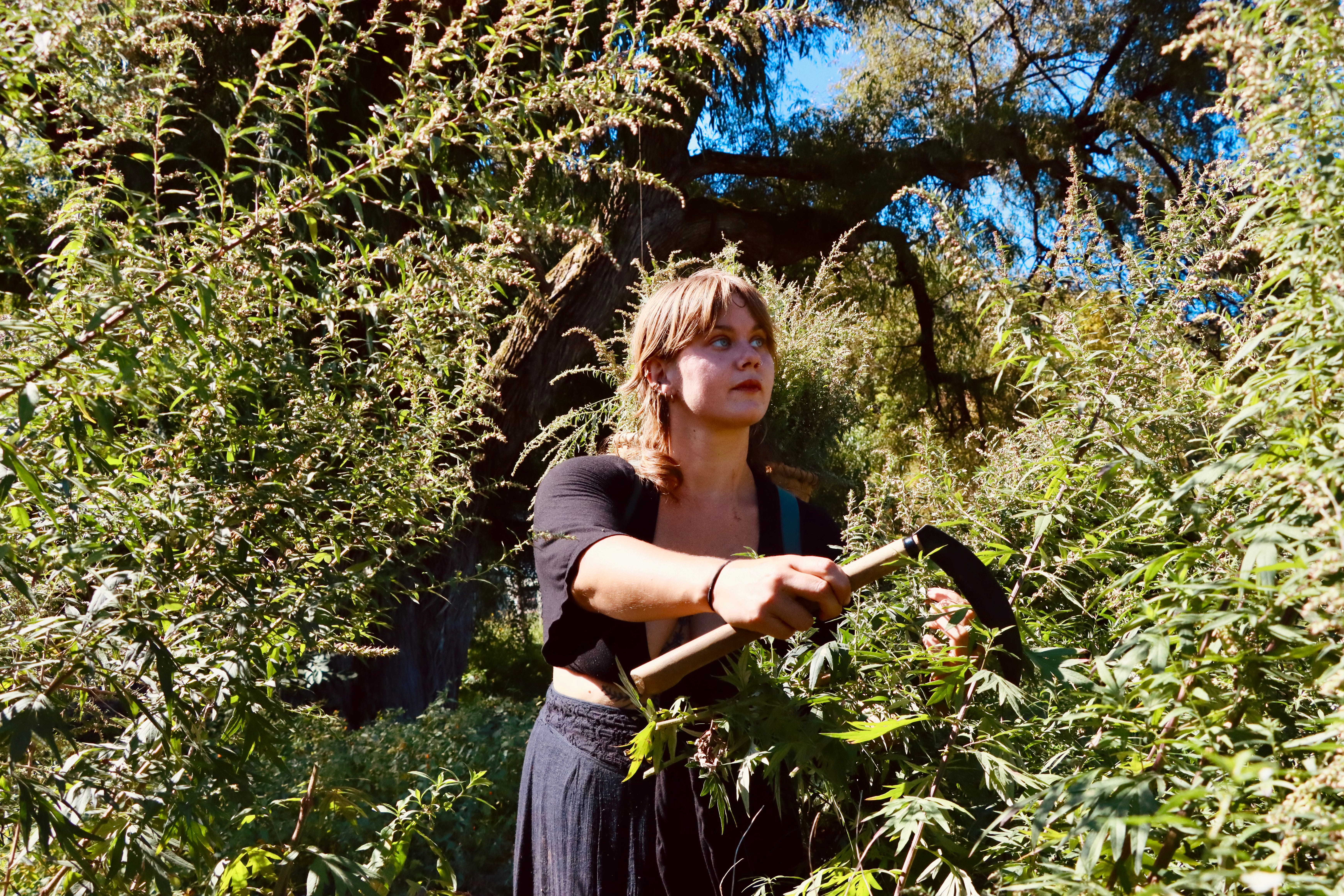
Right now, it’s my last aerial harvest before I dig into root season. I harvest Mugwort in bloom for oil infusions since the aromatics are at their apex. Here I am in my element:
May you slowly savor these last sips of summer,
Jordann
Thank you for reading and being here! You can support me by:
◦ Sharing this letter and giving it a ♡, comment, or reply if it resonates
◦ Shopping the Sensitive Earth Apothecary
◦ Supporting my music on Bandcamp
◦ Buying me a coffee
◦ Upgrading your subscription to paid for $5/month or $3.50/month
The culprit behind the allergies is normally Ragweed (Ambrosia artemisiifolia), who blooms at the same time. Ironically, Goldenrod can help ease allergy symptoms.
This is reference from the foreword of the book: We Do This ‘Til We Free Us by Miriam Kaba
Moerman Daniel E., 1998, Native American Ethnobotany
Densmore, Frances, 1928, Uses of Plants by the Chippewa Indians
Smith, Huron H., 1928, Ethnobotany of the Meskwaki Indians
Fursenco C,et al. Solidago virgaurea L.: A Review of Its Ethnomedicinal Uses, Phytochemistry, and Pharmacological Activities
love the connection between goldenrod, community, and the facial network
yes! and how they all make us whole — solidum agere